How to Protect Outdoor Structures from Hurricane-Season Damage in Acadiana
Living in Louisiana means accepting the reality of hurricane season. The Gulf Coast is not just a vacation destination; it is a frontline for some of the most powerful weather systems on the planet. For homeowners in Lafayette and the surrounding Acadiana region, the threat is not hypothetical. It is an annual operational reality that demands proactive defense. According to the National Weather Service, the Gulf Coast experiences an average of 1.5 tropical storms or hurricanes per year, with wind speeds frequently exceeding 100 miles per hour. This level of atmospheric violence does not discriminate between modern construction and legacy builds. It targets structural weaknesses. (Contact 8211 Acadiana Patios)
Your outdoor living spaces are often the first line of defense and the first to suffer. A patio cover, a screened enclosure, or a concrete slab can become dangerous projectiles or costly liabilities if not engineered for high-wind environments. This guide details the exact methodologies used by professional contractors to fortify these assets. We will move beyond generic advice to discuss material science, anchoring protocols, and the specific engineering standards required to survive Category 3 storms and beyond. (About Us 8211 Acadiana)
Understanding Wind Load and Structural Integrity
Before discussing specific products, you must understand the physics at play. Wind load is the force exerted by wind against a structure. In Acadiana, this force is compounded by wind-driven rain and flying debris. A structure that stands firm in a tropical storm may fail catastrophically in a hurricane due to uplift forces. Uplift occurs when wind flows over the top of a roof or cover, creating a vacuum effect that pulls the structure upward. If the anchoring system cannot resist this upward pull, the entire structure can be ripped from its foundation. (Acadiana Patios amp Construction)
The American Society of Civil Engineers (ASCE) publishes the ASCE 7 standard, which defines wind load requirements for buildings and structures. In Louisiana, local building codes often exceed these national minimums due to the region's specific risk profile. Understanding these codes is not just about compliance; it is about survival. A structure built to code in Florida may not meet the rigorous demands of the Louisiana Gulf Coast. This is why local expertise is non-negotiable. Regional weather data shows that wind gusts in this area can reach speeds that exceed standard residential engineering limits. (Blogs 8211 Acadiana Patios)
When evaluating your current outdoor structures, ask yourself: Was this built to resist uplift? Was the concrete footing depth calculated for the soil composition of your specific lot? These are the questions that separate a durable installation from a seasonal liability.
Material Selection for High-Velocity Winds
The choice of material dictates the structural resilience of your outdoor space. In the humid, corrosive environment of Acadiana, material degradation is accelerated by salt air and constant moisture. Therefore, durability is not just about strength; it is about longevity under stress.
Aluminum vs. Steel
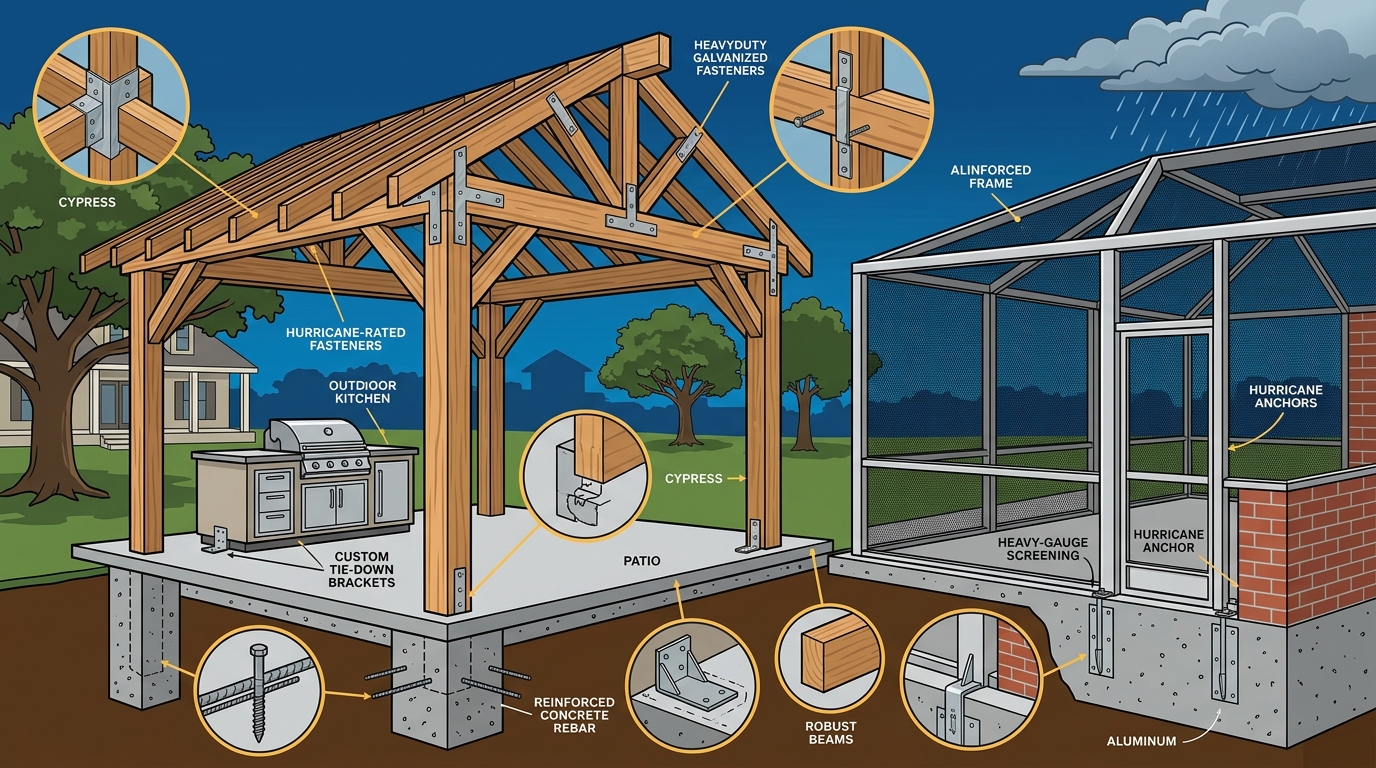
Aluminum is the preferred material for high-end patio covers and sunrooms in this region. It is lightweight, which reduces the dead load on the foundation, yet it offers exceptional strength-to-weight ratios. More importantly, aluminum is naturally corrosion-resistant. Steel, while strong, requires extensive galvanization and coating to prevent rust. Once the coating fails in a salty, humid environment, the structural integrity degrades rapidly. Industry standards for architectural aluminum emphasize its suitability for coastal environments due to its oxide layer formation.
Cypress Wood
For those seeking the aesthetic of traditional Louisiana architecture, cypress wood remains a viable option. Western Red Cypress is naturally resistant to rot and insect damage. However, wood is susceptible to warping and splitting under extreme temperature and humidity fluctuations. To protect cypress structures, they must be sealed and maintained rigorously. In a hurricane, wood structures must be designed with larger cross-sections to compensate for the flexibility of the material compared to metal.
Concrete and Masonry
Concrete patios and driveways are generally immune to wind uplift but are vulnerable to cracking from ground movement and debris impact. Proper reinforcement with rebar and the use of high-psi concrete mixes are essential. Concrete technology advancements have led to fiber-reinforced mixes that offer superior crack resistance, a critical factor in maintaining the integrity of outdoor living spaces.
Critical Anchoring and Foundation Protocols
The strongest material in the world is useless if it is not anchored correctly. The failure point for most outdoor structures during hurricanes is not the roof itself, but the connection between the roof and the ground. This is where professional engineering meets practical installation.
Deep Footings
Standard concrete slabs are often insufficient for supporting heavy patio covers or sunrooms in high-wind zones. Professional contractors use deep footings that extend below the frost line and into stable soil layers. In Acadiana, this often means footings that are significantly deeper than those required in northern climates. The depth ensures that the structure is anchored to a layer of soil that does not shift during heavy rains or storm surges.
Uplift Anchors
Uplift anchors are specialized hardware designed to resist the upward pull of wind. These are not standard nails or screws. They are heavy-duty bolts or straps that connect the structural posts directly to the concrete footing. The connection must be rigid. Any flexibility in the anchor point can lead to fatigue failure over time, especially when subjected to the oscillating winds of a hurricane.
Continuous Load Path
A continuous load path ensures that wind forces are transferred from the roof, down the posts, and into the foundation without interruption. This means using metal connectors and brackets that are rated for the specific load calculations. Building code officials emphasize the importance of this continuous path in preventing progressive collapse during extreme weather events.
Screened and Pool Enclosure Fortification
Screened enclosures and pool cages are particularly vulnerable to wind damage. The screen material acts like a sail, catching the wind and transferring immense force to the frame. If the frame is not reinforced, the entire enclosure can collapse.
Reinforced Frames
Pool enclosures must be built with heavier gauge aluminum or steel frames. The spacing of the vertical posts must be reduced to minimize the span of the screen material. This reduces the surface area exposed to direct wind pressure. Additionally, the roof of the enclosure must be designed to shed water and resist uplift. A flat roof is a liability; a pitched roof is a necessity.
Removable Screens
For seasonal protection, some homeowners opt for removable screen panels. While this eliminates the sail effect, it introduces the risk of improper reinstallation or loss of panels. If you choose this route, the mounting hardware must be robust enough to withstand the repeated stress of removal and reattachment. Pool enclosure safety guidelines often recommend permanent, reinforced structures for areas with frequent hurricane threats.
Pre-Season Maintenance and Inspection Checklist
Even the best-built structures require maintenance. Before hurricane season begins, typically in June, conduct a thorough inspection of all outdoor structures. Look for loose bolts, corroded connectors, and cracked concrete. Tighten any loose hardware and replace any compromised components. This proactive approach can mean the difference between a minor repair and a total loss.
Clear Debris
Keep the area around your structures clear of debris. Loose objects can become projectiles that damage your screens, roofs, and siding. Trim back any trees or shrubs that are within 10 feet of your outdoor living spaces. Falling branches are a common cause of structural damage during storms.
Check Drainage
Ensure that water drains away from your foundation and footings. Standing water can weaken the soil support, leading to settling and structural misalignment. Proper grading and gutter systems are essential for maintaining the integrity of your outdoor spaces.
Insurance Implications and Liability
Insurance companies are increasingly scrutinizing the construction quality of outdoor structures. Homes with poorly built or unpermitted additions may face higher premiums or even denial of coverage. Ensuring that your structures are built to code and installed by licensed professionals can help mitigate these risks. Insurance best practices suggest that documented compliance with local building codes can lead to significant discounts on windstorm insurance policies.
Furthermore, liability is a major concern. If a structure fails and damages a neighbor's property or injures a person, you can be held legally responsible. Proper engineering and installation protect you from these legal and financial liabilities. It is an investment in peace of mind.
Key Takeaways
- Wind Load is Critical: Structures must be engineered to resist both downward pressure and upward uplift forces specific to the Gulf Coast.
- Material Matters: Aluminum offers superior corrosion resistance and strength-to-weight ratios compared to steel or wood in coastal environments.
- Anchoring is Key: Deep footings and uplift anchors are non-negotiable for preventing structural failure during high winds.
- Local Expertise: Contractors familiar with Acadiana soil conditions and local building codes provide essential protection.
- Maintenance Prevents Failure: Regular inspection and tightening of hardware can prevent catastrophic failures during storms.
- Insurance Benefits: Code-compliant structures may qualify for lower insurance premiums and reduce liability risks.
- Professional Installation: DIY installations often lack the engineering rigor required for hurricane survival.
Frequently Asked Questions
What is the best material for a patio cover in hurricane-prone areas?
Aluminum is generally considered the best material due to its high strength-to-weight ratio and natural resistance to corrosion from salt air and humidity. It does not rust like steel or warp like wood, making it ideal for the Acadiana climate.
How deep should concrete footings be for a patio cover?
Footings must extend below the frost line and into stable soil. In Louisiana, this often requires deeper footings than in northern states to ensure stability against soil shifting and uplift forces. Local building codes dictate specific depths based on soil composition.
Can I remove my screened enclosure before a hurricane?
While removing screens reduces wind load, it is often impractical and risky. The mounting hardware can be damaged during removal, and the panels can be lost. It is safer to have a permanently reinforced enclosure designed to withstand high winds.
Does building to code guarantee my structure will survive a hurricane?
Building to code ensures that your structure meets minimum safety standards for expected wind loads. However, no structure is immune to extreme, unprecedented weather events. Proper maintenance and engineering significantly increase the likelihood of survival.
How often should I inspect my outdoor structures?
Inspections should be conducted annually, preferably before hurricane season begins. Look for loose bolts, corrosion, cracks in concrete, and any signs of settling or misalignment.
What is the difference between a patio cover and a sunroom?
A patio cover is typically an open-sided structure designed to provide shade and shelter from rain. A sunroom is a fully enclosed space with windows or screens, offering a more permanent extension of the living space. Both require robust anchoring for hurricane protection.
Why is professional installation important for hurricane protection?
Professional installers understand the local building codes, soil conditions, and wind load requirements. They use proper engineering techniques and high-quality hardware that DIY installations often lack, ensuring the structure can withstand extreme weather.
Secure Your Home Today
Do not wait for the next storm to test the integrity of your outdoor living spaces. Protect your investment and your family with structures built to withstand the harshest conditions. Acadiana Patios & Construction has been serving Lafayette and the surrounding areas since 1985. We combine decades of experience with rigorous engineering standards to deliver homes that stand strong against the elements. Contact us today for a free estimate and discover how we can fortify your property.