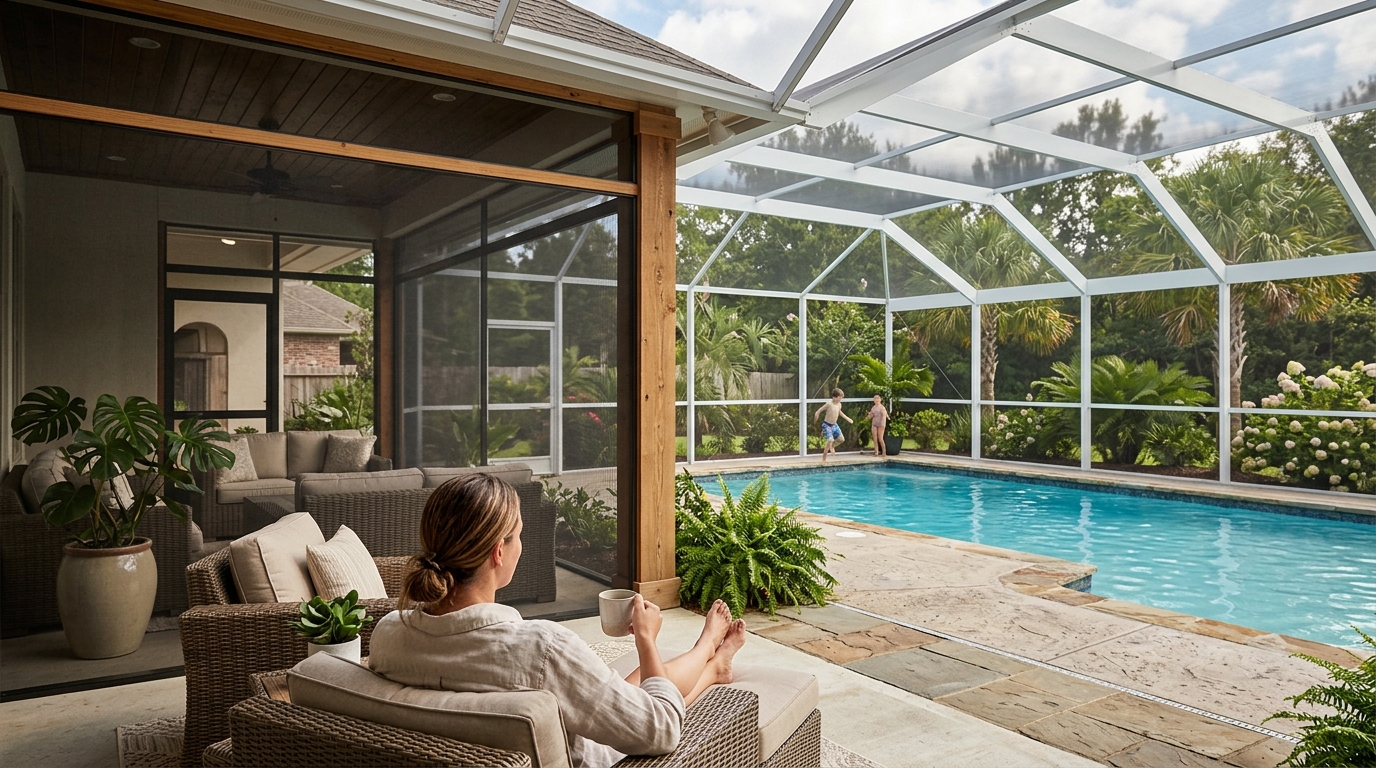
Homeowners in Louisiana face unique weather challenges that directly impact the usability of their outdoor living spaces. According to the National Oceanic and Atmospheric Administration, the Gulf Coast region experiences significant humidity and seasonal storm activity that can limit pool usage to just a few months of the year. This environmental reality forces many property owners to choose between extending their swimming season through thermal retention or simply keeping the area clean and bug-free. The decision between a pool enclosure and a screened enclosure is not merely aesthetic. It is a functional choice that determines how much value you extract from your investment annually.
Thermal Retention and Season Extension
The primary functional advantage of a pool enclosure is its ability to trap heat. These structures typically utilize polycarbonate or glass panels that create a greenhouse effect. This mechanism raises the air temperature inside the enclosure by ten to fifteen degrees compared to the outside environment. For swimmers in Lafayette, this means extending the swimming season well into the cooler months of late autumn and early spring.
A screened enclosure, by contrast, does not retain heat. Its primary function is ventilation and exclusion. While it keeps the pool area comfortable by allowing cross-breezes, it does not warm the water or the air. If your goal is to swim year-round or during chilly evenings, a screened structure will not provide the thermal benefits required for comfort. The choice here depends entirely on your desire for temperature control versus natural airflow.
Maintenance and Debris Management
Maintenance requirements differ significantly between these two structures. A screened enclosure acts as a physical barrier against leaves, twigs, and larger debris. This drastically reduces the workload for pool cleaners and skimmers. However, screens can degrade over time due to UV exposure and require occasional patching or replacement. They also allow dust and pollen to enter, which may require more frequent vacuuming of the pool floor.
Pool enclosures offer a higher level of protection against organic debris. Because the structure is sealed, leaves and insects cannot enter the pool area. This results in cleaner water and reduced chemical usage, as contaminants that alter pH levels are kept out. The trade-off is ventilation. Enclosures can become humid and hot if not properly ventilated. Proper airflow design is critical to prevent condensation and mold growth within the structure. Acadiana Patios & Construction ensures that every screened enclosure and pool structure is designed with local climate conditions in mind to balance airflow and protection.
Cost Analysis and Return on Investment
Financial considerations play a major role in this decision. Generally, a custom patio cover or screened structure costs less than a fully insulated pool enclosure. The materials required for thermal retention, such as insulated panels and heavy-duty framing, increase the initial price point. However, the return on investment for a pool enclosure often comes from increased usability. Homeowners who swim year-round get more value from their initial construction costs.
Screened enclosures provide excellent value for homeowners who prioritize low maintenance and bug-free comfort during the primary swimming season. They are a cost-effective way to protect the pool area without the complexity of thermal management. When evaluating these options, it is essential to consider the long-term operational costs. Enclosures may save money on pool chemicals and heating bills over time, while screened enclosures may incur lower initial installation costs but require more frequent cleaning of the pool itself.
Aesthetics and Architectural Integration
The visual impact of your choice will define the look of your backyard. Screened enclosures are designed to blend into the landscape. They use fine mesh screens that are nearly invisible from a distance, preserving the view of your yard and the pool. This creates an open, airy feel that many homeowners prefer for a natural Louisiana aesthetic.
Pool enclosures are more prominent architectural features. They can be designed with clear panels to maintain visibility or tinted panels for privacy and glare reduction. The structure itself becomes a focal point. Some homeowners choose to integrate outdoor kitchens or fireplaces into the enclosure design to create a complete entertainment hub. The choice here depends on whether you want your pool area to feel like an extension of the outdoors or a distinct, controlled indoor-like environment.
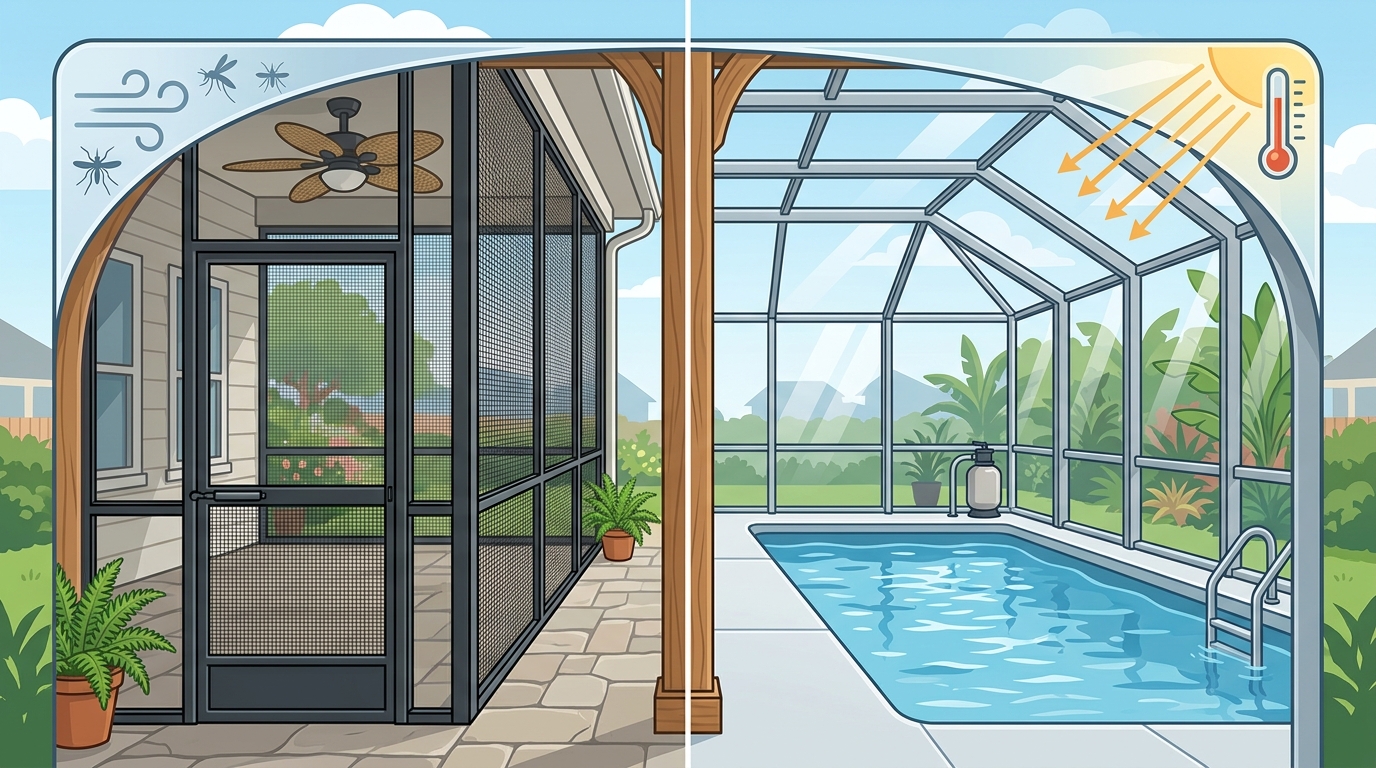
Feature Comparison Summary
| Feature | Pool Enclosure | Screened Enclosure |
|---|---|---|
| Thermal Retention | High (Greenhouse Effect) | Low (Ventilated) |
| Debris Protection | Complete (Sealed) | Partial (Mesh Barrier) |
| Maintenance Level | Low (Cleaner Water) | Medium (More Cleaning) |
| Season Extension | Year-Round Potential | Seasonal Only |
| Initial Cost | Higher | Lower |
| View Preservation | Variable (Glass/Polycarbonate) | High (Invisible Mesh) |
Key Takeaways
- Pool enclosures trap heat, potentially extending the swimming season by several months in Louisiana.
- Screened enclosures provide excellent bug protection and airflow but do not retain thermal energy.
- Acadiana Patios & Construction has served the Lafayette area since 1985, ensuring decades of local expertise.
- Enclosures reduce pool maintenance by keeping organic debris completely out of the water.
- Screened enclosures are generally more affordable to install than insulated pool structures.
- Both options add significant value to a home by expanding usable outdoor living space.
- Proper ventilation is critical in pool enclosures to prevent humidity buildup and structural damage.
Frequently Asked Questions
Can I swim in my pool during the winter with an enclosure?
Yes, a properly designed pool enclosure can trap enough heat from the sun to keep the water and air warm enough for comfortable swimming even in cooler months. This is a primary benefit over screened enclosures.
Do screened enclosures keep mosquitoes out?
Yes, screened enclosures are specifically designed with fine mesh to keep insects like mosquitoes and flies out while allowing air to flow freely through the structure.
How long do pool enclosures last?
High-quality pool enclosures, when maintained properly, can last for decades. The materials used, such as aluminum framing and polycarbonate panels, are chosen for durability and resistance to UV damage.
Is a pool enclosure considered a permanent structure?
Most pool enclosures are considered permanent structures and may require building permits. It is important to check local regulations in Lafayette and Acadiana before proceeding with installation.
Can I add lighting to my enclosure?
Absolutely. Both pool enclosures and screened enclosures can be fitted with electrical wiring for lighting, fans, and even heating elements to enhance comfort and usability.
Which option is better for privacy?
Pool enclosures with tinted or frosted panels offer more privacy than screened enclosures, which are largely transparent. However, screened enclosures can be fitted with privacy screens if needed.
Do I need to remove snow from a pool enclosure?
While snow is rare in Lafayette, in regions with heavy snowfall, the strong frame of a pool enclosure is designed to support the weight. Regular inspection of the structure is recommended to ensure integrity.
Contact Acadiana Patios for Your Estimate
Choosing between a pool enclosure and a screened enclosure requires a professional assessment of your property and lifestyle needs. Acadiana Patios & Construction offers free estimates to help you make the best decision for your home. As a trusted renovation contractor in Lafayette, Louisiana, we bring over 30 years of experience to every project. We are committed to delivering high-quality materials and expert craftsmanship. Contact us today to discuss your patio design and installation needs. Let us help you create the perfect outdoor living space.