Common Pool Barrier Compliance Mistakes in Acadiana and How to Avoid Them
Swimming pool safety is not merely a local preference in Louisiana; it is a strict legal mandate designed to prevent drowning incidents. According to the Centers for Disease Control and Prevention, drowning remains a leading cause of unintentional injury death for children aged 1 to 4, making compliant pool barriers essential for every homeowner in the region. Acadiana Patios & Construction has served the Lafayette and Acadiana areas since 1985, witnessing firsthand how often well-meaning homeowners inadvertently violate state and local codes. This guide details the most frequent compliance errors and provides the professional strategies needed to ensure your pool enclosure meets all safety standards.
Understanding Height and Clearance Requirements
One of the most common mistakes homeowners make is underestimating the precise height requirements for pool barriers. Louisiana state law generally mandates that pool barriers must be at least 48 inches high, measured on the outside of the barrier. This measurement is critical because even a few inches of variance can render a fence non-compliant during an inspection.
Another frequent error involves the clearance at the bottom of the barrier. The gap between the bottom of the fence and the ground must typically not exceed 4 inches. This prevents small children from crawling underneath the barrier. When installing a screened enclosure, homeowners often fail to account for the settling of the concrete slab or the expansion of the ground, which can widen this gap over time.
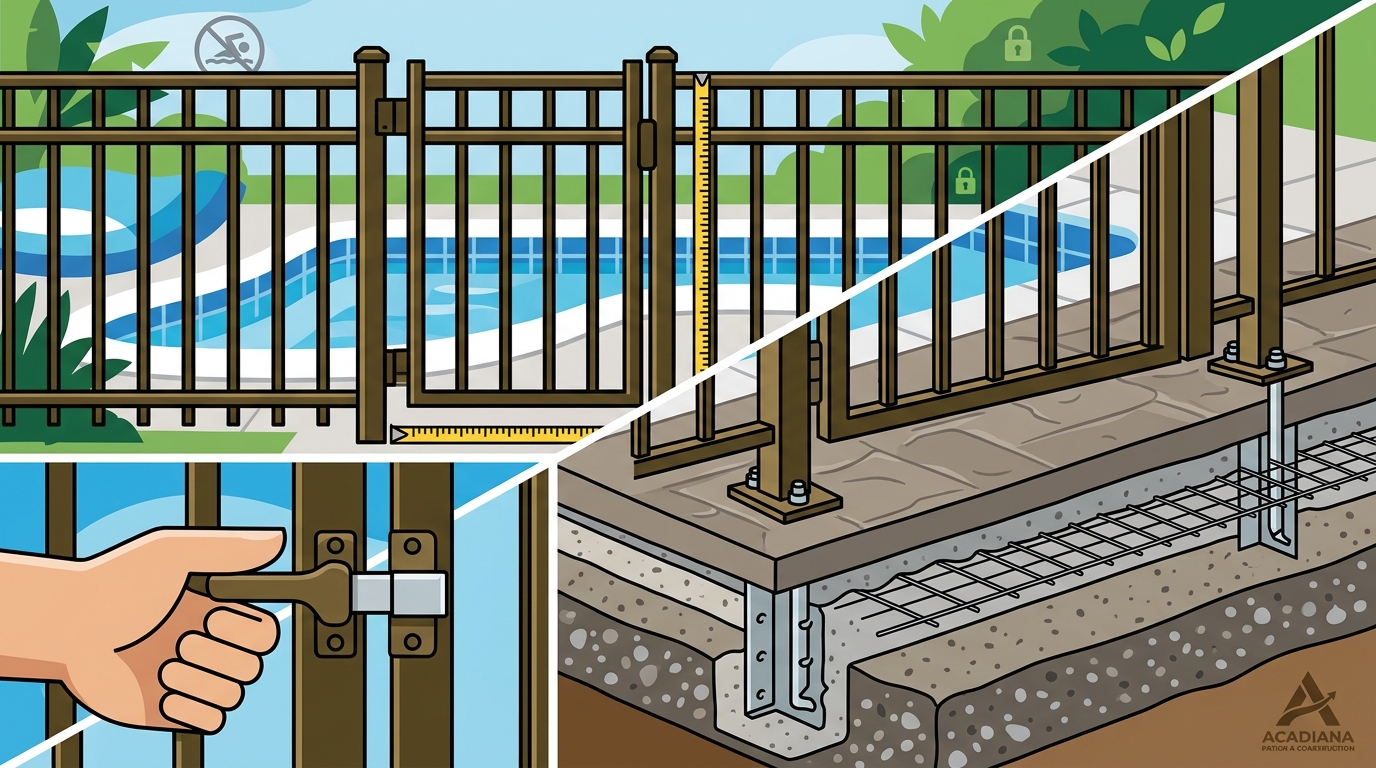
Acadiana Patios & Construction ensures that every pool enclosure is installed with precise leveling and foundation work. Our team understands that the terrain in Lafayette and surrounding Acadiana parishes can shift, requiring robust anchoring systems to maintain the integrity of the barrier height over decades of use.
Gate Mechanism and Latch Failures
The pool gate is the most vulnerable point in any barrier system. A common mistake is the installation of gates that do not self-close and self-latch automatically. State codes require that gates open outward, away from the pool, and must close and latch automatically from any open position. If a gate relies on a manual latch or a simple magnet, it is non-compliant and dangerous.
Another critical error involves the placement of the latch mechanism. The latch must be located on the pool side of the gate, at least 54 inches from the bottom of the gate, or it must be a key-operated locking mechanism located on the outside. If the latch is too low, a young child can reach it and open the gate. Furthermore, the latch must be shielded or positioned so that it cannot be released by simple pressure or manipulation.
At Acadiana Patios & Construction, we specialize in installing high-quality motorized shades and screens that integrate seamlessly with pool enclosures. Our installations include commercial-grade self-closing hinges and certified latches that meet the rigorous standards of the Louisiana Home Builders Association. We ensure that every gate operates smoothly and reliably, regardless of humidity or temperature fluctuations.
Avoiding Climbable Structures and Gaps
Pool barriers must be non-climbable. A frequent mistake is installing fences with horizontal rails, decorative cutouts, or ornamental ironwork that provides footholds for children. If the barrier has horizontal components, the spacing between them must be wide enough to prevent climbing, or the design must be vertical to eliminate footholds entirely.
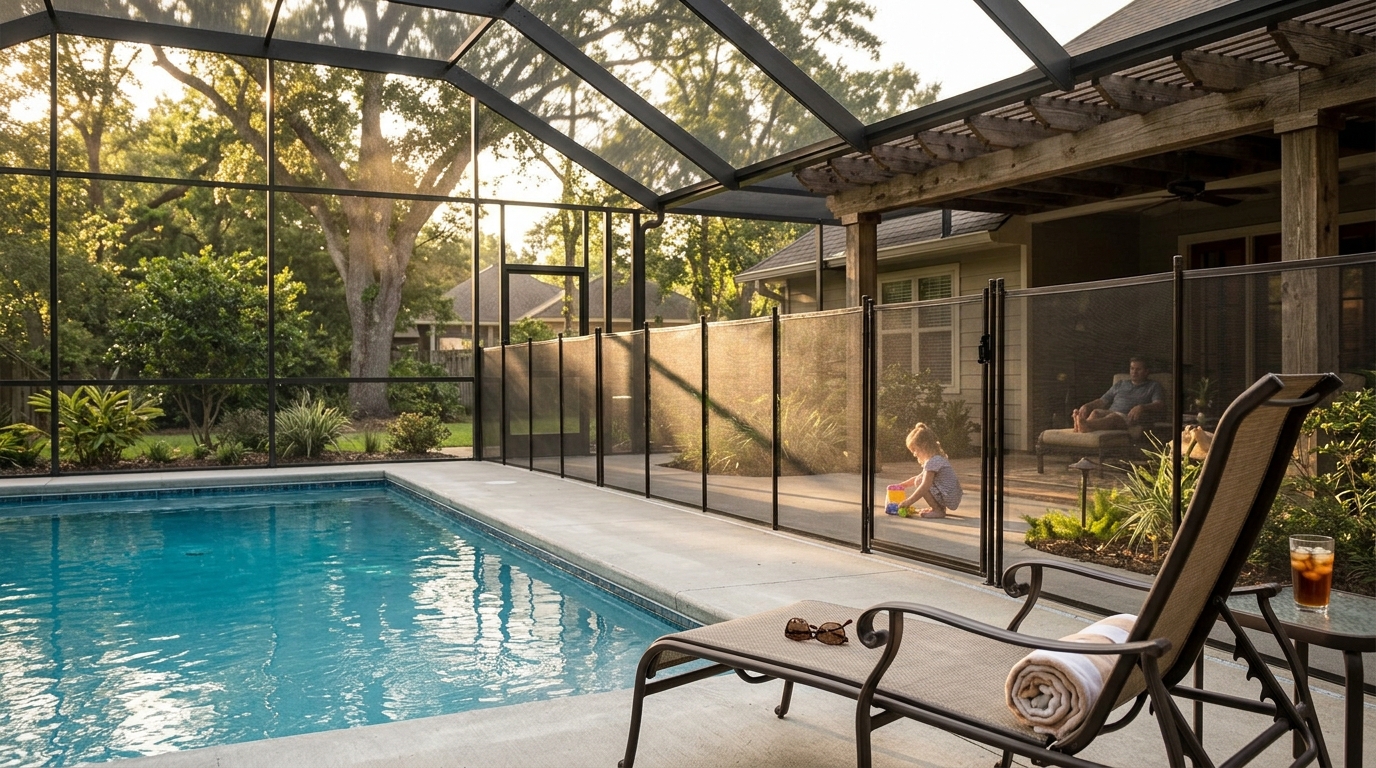
Gaps in the barrier are another significant compliance issue. The mesh in screened enclosures must have openings small enough to prevent a 4-inch sphere from passing through. Similarly, any gaps between vertical pickets must not exceed 4 inches. Homeowners often overlook the area where the pool fence meets the house. If the house wall serves as part of the barrier, windows and doors leading to the pool area must have protective barriers or alarms.
Our team at Acadiana Patios & Construction designs patio covers and sunrooms with safety in mind. We use materials and designs that minimize climbability while maximizing aesthetic appeal. Whether you choose a cypress patio cover or an aluminum enclosure, we ensure that the structure does not provide any unintended climbing aids.
The Professional Inspection Checklist
Regular inspections are vital for maintaining compliance. Homeowners should check their barriers at least once a month for damage, wear, or malfunction. Key items to inspect include:
- Gate Operation: Does the gate close and latch automatically every time?
- Hardware Integrity: Are hinges, latches, and screws tight and undamaged?
- Structural Stability: Is the fence or enclosure rigid and free of wobble?
- Gap Measurements: Are all gaps less than 4 inches?
- Clearance: Is the bottom clearance less than 4 inches?
While DIY inspections are helpful, a professional inspection provides peace of mind. Acadiana Patios & Construction offers expert assessments of existing barriers. We can identify potential compliance issues before they become safety hazards or legal liabilities. Our team is familiar with the specific codes enforced in Lafayette, Louisiana, and the broader Acadiana region.
Material Selection for Louisiana Climate
The Louisiana climate poses unique challenges for pool barriers. High humidity, heavy rainfall, and intense UV exposure can degrade materials over time. A common mistake is choosing materials that are not suited for this environment, leading to rust, rot, or warping. For example, untreated wood may warp, causing gaps to form in the barrier. Aluminum, while durable, must be properly coated to prevent corrosion.
Insulated patio covers and cypress pavilions are excellent choices for Acadiana homeowners. Cypress wood is naturally resistant to rot and insects, making it ideal for the humid Louisiana climate. Aluminum enclosures offer a low-maintenance alternative that does not rust or corrode. Both options can be designed to meet strict compliance standards while enhancing the beauty of your outdoor living space.
At Acadiana Patios & Construction, we partner with leading manufacturers to provide high-quality products that withstand the test of time. Our materials come with warranties up to 10 years, ensuring that your investment remains safe and compliant for decades. We also offer concrete slab installation to provide a stable foundation for your barrier system.
Key Takeaways
- Pool barriers in Louisiana must be at least 48 inches high with no more than a 4-inch gap at the bottom.
- Gates must self-close, self-latch, and open outward from the pool.
- Latches must be placed at least 54 inches from the bottom or be key-operated.
- Barriers must be non-climbable, with no horizontal footholds or gaps larger than 4 inches.
- Regular inspections are necessary to maintain compliance and safety.
- Material selection should account for the humid Louisiana climate to prevent degradation.
- Professional installation by a licensed contractor ensures adherence to all local codes.
Frequently Asked Questions
What is the minimum height for a pool fence in Louisiana?
The minimum height for a pool barrier in Louisiana is generally 48 inches, measured from the ground on the outside of the barrier.
Do pool gates need to self-close and self-latch?
Yes, all pool gates must automatically close and latch from any open position to ensure safety.
Can I use my house as part of the pool barrier?
Yes, but windows and doors leading to the pool area must have protective barriers or alarms to prevent unauthorized access.
What materials are best for pool enclosures in Acadiana?
Cypress wood and aluminum are excellent choices for Acadiana due to their resistance to humidity and rot.
How often should I inspect my pool barrier?
Homeowners should inspect their barriers at least once a month for damage, wear, or malfunction.
Is professional installation required for pool barriers?
While not always legally required, professional installation ensures compliance with local codes and safety standards.
What is the maximum gap allowed under a pool fence?
The gap between the bottom of the fence and the ground must not exceed 4 inches.
Contact Acadiana Patios for Compliance
Ensuring your pool barrier is compliant is crucial for the safety of your family and guests. Acadiana Patios & Construction is here to help. With over 30 years of experience serving Lafayette and Acadiana, we provide expert design, installation, and inspection services. Contact us today for a free estimate and ensure your pool enclosure meets all safety standards.